An improved design for a portable medical grade refrigerator
What?
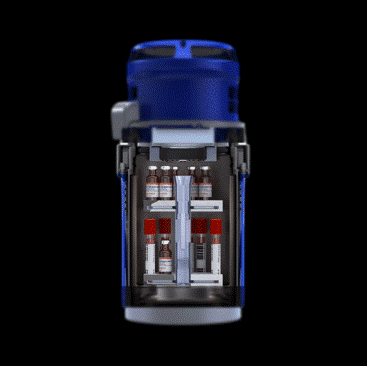
As a part of my Air conditioning and refrigeration class, we collaborated with an Indian based portable medical-grade refrigerator manufacturing company called as Black Frog. We were supposed to improve the efficiency of their product Emvólio. I used Solidworks to design and Ansys thermal to validate our results.
How?
To improve the efficiency, first we have to understand how the refrigerator works. Emvólio uses a solid state refrigerator called as Peltier cooler which operates based on reverse Seebeck effect or the Peltier effect. After checking the other parameters like cold air distribution, we were left no choice but to work on improving the efficiency of this Peltier cooler in order to improve the efficiency.


Peltier cooler module and the Seebeck effect
In order to achieve this, I tried to understand how the Peltier cooler works and how making changes to the parameters relied on it would affect the performance of the refrigerator. Two things we observed was that increasing the voltage difference (more power), we could achieve faster cooling because the cold side of the cooler will stay at much lower temperature. But of course, our goal was to improve the efficiency not faster cooling. Another key observation was that there was a fixed delta in-between the hot side and the cold side of the Peltier module. Meaning that if we can reduce the hot side temperature by 5 deg Celsius, we can expect the cold side temperature to reduce by 5 deg Celsius too (but in reality that is not the case, usually as the temperature goes down, the delta reduces). So we planned to reduce the temperature of the hot side, again passively so that we do not consume more energy to keep the Peltier plate cooler.


on-off cycle of a refrigeration system
Test setup using vapor chamber
In our R&AC class we came across the concept of on-off cycle based on how usually all the refrigerators works. Lets say that we need the room to be at a certain temperature. The system sets a control variable based on this temperature to instruct when the cooling system should turn on and off. So in order to increase the efficiency of the refrigerator, we need to reduce the amount of on time. We came up with a clever way to solve this by using a vapor chamber. Vapor chamber is essentially a device in which a liquid is stored in vacuum which absorbs the heat from the hot surface thereby evaporating and cooling the surface much more efficiently than a solid block of metal like fins. By using this we can remove the heat much more efficiently from the hot surface reducing its temperature, ultimately reducing the cold side temperature respectively. This vapor chamber acts as a heat reservoir which can dissipate heat later during the off cycle.
Results
Using some assumptions for the thermal conductivity for the vacuum chamber we did a thermal analysis using Ansys to compare the performance with an without the vapor chamber. The simulation showed a 33% improvement in the time it takes to cool the refrigerator on a normal on cycle. Though this has to be verified using actual test setup, even if there is a 20% reduction in the on cycle, would save the company $126 per machine per year on an average operational cycle. More than that a lot of man hours used to transport this refrigerator in an out of remote places can also be reduced improving the efficiency.

Time vs Temperature performance with and without vapor chamber
But after this project concluded, we found out that using a bigger size vapor chamber and thermal paste to even more efficiently removing the heat from the hot side would improve the performance. This was just a concept that's long been used in laptops and other electronic devices, but we used them here in an eccentric manner to improve the performance of a solid state refrigerator. It should also be noted that this vapor chamber concept will work only with cycle loads and will not be as effective on a constant load cycle. Since our application had a cyclic load, we were able to effectively use them here.