ASU MORE Symposium Fall 2022


_HEIC.png)
Out of nearly a thousand applicants, I had the honor of being one of the few students selected to participate in the Master’s Opportunity for Research in Engineering (MORE) symposium, which was hosted by Arizona State University during the Fall 2022 semester. This symposium provided students from various disciplines across the university with the unique opportunity to showcase cutting-edge technologies developed in their respective fields to industry experts, the general public, and undergraduate students. During the event, I had the privilege of presenting my master's thesis research, which focuses on additive manufacturing, unconventional manufacturing, and rapid prototyping. I emphasized how these technologies, particularly when applied to advanced composites, have the potential to shape the future.
Catia design Project
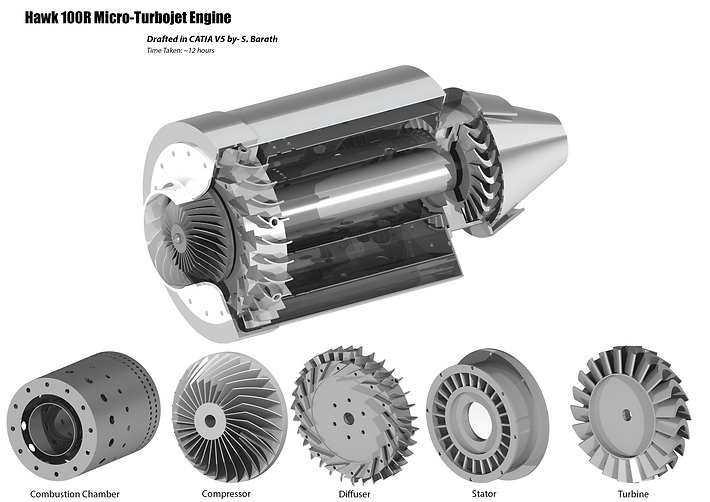
During my undergrad, to hone my Catia V skills, i worked on designing a model of Hawk 100R micro turbojet engine. I completed this whole project in a span of 3 days including the part design and assembly and a combined 12 hours to complete this.
Computational Fluid Dynamics- Ansys Fluent
Internal Flow

(1) Compressible flow inside a cylinder

(2b) Cross-section contour of viscous heating across a tube

(2a) Viscous heating of fluids flowing through a tube

(3) Effect of temperature of fluids on buoyancy
CFD of internal flows were studied in this project like, how to create an internal flow boundary conditions for different types of flow and how to get temperature and velocity contours for those simulations. The projects I worked on here are as follows.
-
Compressible flow: Studied a simple compressible flow across two cylinders. Here the left chamber was pressurized to a higher pressure as an initial boundary condition. As the simulation proceeds the compressed air is allowed to pass through the nozzle and the change in pressure, density and temperature were studied across the contour. Through this project, I understood how through a CFD simulation we can observe the change in pressure and how it can affect the temperature and density across the contour.
-
Internal flow with heat source: In this project, a fluid is allowed to flow through a spring like structure. I used two working fluid water and motor oil with different viscosities. Water has lower viscosity and the oil has a higher viscosity. Through this simulation, I observed the effects of viscous heating, and how viscosity and the velocity of the fluid affects the fluid temperature. Image (2a) shows the temperature of the fluid as it proceeds through the tube and image (2b) shows a cross section contour to observe of temperature. In this image (2b) we can observe that the fluid flowing along the inner edge of the wall faces more friction and thus it heats up more (although, the difference in temperature is tiny)
-
Internal flow with thermal convection: Studied the correlation between temperature of the fluid and how it affects its buoyancy. In this project, the fluid enters the chamber through the top inlet and the bottom plate was heated. We also monitored the outflow temperature and how long it takes to reach a certain temperature.
Multiphase Flow
(1) Methane gas leak into atmosphere
(2) Water droplet on gasoline
(3) Glycerin droplet spreading on an inclined surface
(4) Fluid draining through a sink
Fluid simulation of multiple phases of fluids were studied during this project. Volume of Fluid (VOF) method was predominantly used. In this projected we came across
-
Interaction between two gasses: A gas leak scenario was studied where methane is leaked from an underground pipe and mixes with air having a gentle breeze.
-
Interaction between two liquid and gas: A droplet of water freefalling through atmospheric air onto a container with gasoline is simulated through this experiment.
-
Interaction between liquid, solid and gas: Here I studied how a droplet of glycerin will spread on a solid surface inclined at an angle. Interactions between solid floor, liquid glycerin and gaseous atmospheric air can be observed through this simulation. Also here concept of iso-contour, where the shape of our contour changes and adapts based on the deformation of fluid surface was used.
-
Interaction between liquid, air and solid (concepts of viscosity and cross-section): In this simulation, two fluids, water and motor oil was allowed to drain through the outlet at the bottom of the container. I understood how viscosity and density of the fluid affects the time taken for the fluids to completely drain through this simulation.
External flow

(1) Changes in velocity magnitude due to obstacle

(2) Wake region behind an UFO like object
Though this project I studied for we can conduct CFD simulation on an external surface. These two simulation depicts how fluids flow around the surface and I got a better understanding of fluid dynamics concepts like wake region and how it contributes to lift and drag and how vortex affects the performance of aircrafts and automobiles.
National level Ansys competition

Project summary

Me (center) and my friends after wining the National Level Ansys competition

Our school Principal congratulating us after winning our competition.
After securing first place in the divisional and state level Ansys competition, me and my teammate Geoffrey Samuel went on to participate in a national level competition hosted by Society of Automotive Engineers India (SAE India). We won the national level competition by performing transient structural analysis on a connecting rod of a 4-cylinder inline engine. I am proud to say that we were the first from my school to go to a national level competition hosted by SAE and win a prize, for which my college congratulated us and gave a sum of 10,000 rupees as a token of appreciation.
MDIW design and Flow simulation
MDIW nozzle designed using Solidworks
Two phase flow simulation using Solidworks CFD
Multiphase Direct Ink Writing (MDIW) is an in-house developed Direct Ink writing (DIW) additive manufacturing technique which allows us to use multiple material to be printed at a same time if the rheological properties of both the fluids matches one another. There are a lot of multi-nozzle DIW nozzles that has been explored by researchers, but this nozzle allows us to print those two inks into multi layered patterns which can have unique applications in 4D printed smart materials and microprocessor packaging applications. During my time as a research assistant, we went back to the drawing board to do small revisions to this nozzle and perform CFD simulations using two fluid we had been working on at that time. Both the design and CFD simulation were done using Solidworks.
Biocompatible Stent design & simulation

Stent design
Stent pressure simulation
One of my fellow research student is working on a biocompatible 3D printable stents that are used on patients with blocked or weakened arteries. We worked on a gelatin based bio composite and wanted to study how this stent would deform under internal pressure similar to of human arteries. So we designed the model of this stent using Solidworks and simulation using Ansys static structural. Though not exactly a pressure vessel simulation, it uses the basic concepts of thin walled tubular structure under pressure, to identify the optimum thickness and length to withstand the working condition.